How to predict by coordinate

Input the genomic coordinates of your region of interest, using hg38 as the reference genome. This input is the most flexible, and is unconstrained by sequencing coverage or any annotation. Be sure to double-check that the output sequence matches your expected region, and check that the output coverage of A/C bases is above the recommended 70%, which is reflective of DMS-modifiable bases meeting all coverage and quality filters.

For most users, only one set of coordinates will be used to define their region of interest. However, two sets of coordinates may be needed when joining two separate regions together, such as when crossing a splice junction.

When analyzing a region within a larger transcript, it is generally recommended to test “buffer” regions, where the region of interest should be extended by 20-50 nt on each end in order to reduce the likelihood of structures being arbitrarily interrupted by the region borders.

Due to computational and server constraints, users will be limited to a maximum input length of 500 nucleotides and a maximum output of 5 predicted structures, though some regions may yield fewer than that. If this does not suit your needs, consider downloading and running the data and code locally (see Download ).
Predict by Gene


Advanced Options
Chromosomal Coordinates (max 500bp)
Coords 1  
Additional Coordinates
Coords 2 Optional
Coords 3 Optional
Coords 4 Optional


OAZ1
ENST00000602676 (+) ENSG00000104904 (+)

Visualize entire gene
100
150
300
500
+
-
Predict

  Region Local Coords Chrom Coords Length R N Gini Action
1
5'UTR,CDS 7-110 2269526-2269629 104 0.9325 50 0.29
2
CDS 111-187 2269630-2269706 77 0.9604 50 0.21
3
CDS 188-289 2269707-2269744 / 2271385-2271442 / 2271444-2271449 102 0.9579 50 0.34
4
CDS 290-380 2271450-2271530 / 2271782-2271791 91 0.9642 50 0.34
5
CDS 383-458 2271794-2271869 76 0.9580 50 0.28
6
CDS 460-565 2271871-2271954 / 2272735-2272756 106 0.9696 50 0.41
7
CDS 567-666 2272758-2272820 / 2272972-2273008 100 0.9721 50 0.35
8
CDS,3'UTR 668-772 2273010-2273114 105 0.9338 50 0.31
9
3'UTR 773-884 2273115-2273226 112 0.9651 50 0.40
10
3'UTR 885-1012 2273227-2273354 128 0.7243 50 0.23
11
3'UTR 1014-1103 2273356-2273445 90 0.5203 34 0.34
Download CSV

Custom Gene Windows

Gene Window Instructions/Interpretation
  1. Search for a gene by name. For each gene, only the canonical transcript (as defined by UCSC in GRCh38.106) is shown. Some gene names may correspond to multiple genomic locations.
  2. For the selected gene, a scatterplot showing the Gini indices, where a high Gini index corresponds to a highly-structured region, for small windows within the transcript. For small RNAs, these windows are sized 20 valid (coverage- and quality-filtered) A/C data points; for all other transcripts, these windows are sized 50 valid A/C data points, due to the ability of DMS to modify primarily A/C bases. In regions with sufficient coverage, these windows correspond to actual transcript lengths of roughly 40 and 100 nucleotides, respectively.
  3. Select a window of interest, either from the scatter plot or from the table below. Generally, windows with a high Gini will yield better results, where the DMS signal aligns more accurately with the predicted base-pais. Windows with high Gini indices relative to the rest of the transcript can also be used to find functional structural elements (ex: TFRC iron response elements).
  4. If previously-defined windows do not suit your needs, you can define a custom window either using (1) the slider below the scatterplot, which shows both a heatmap of previously-defined windows as well as the locations of each UTR and CDS; or (2) custom coordinate-based entry via Predict by Coordinates.
See About for more information on the dataset and for best practices in structure determination.

completed
7
OAZ1

Aoi: Chr: Coords Strand:
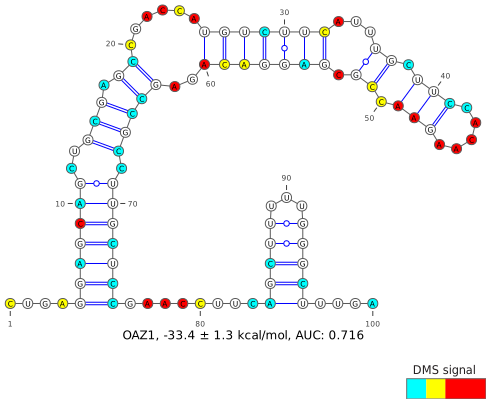
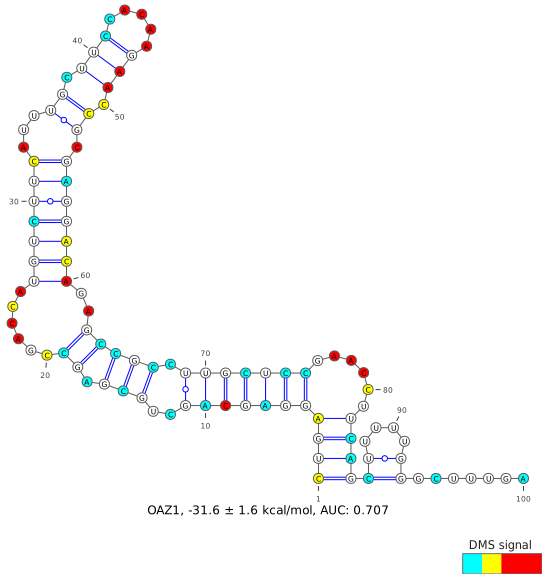
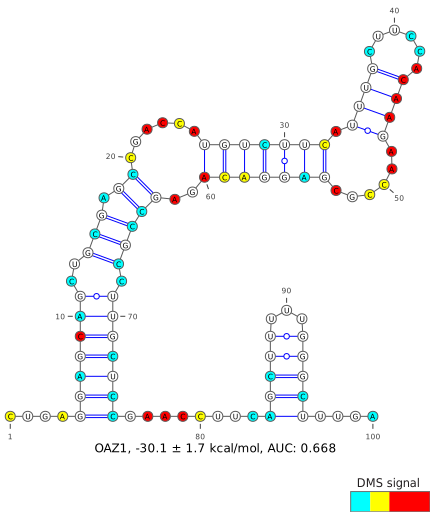
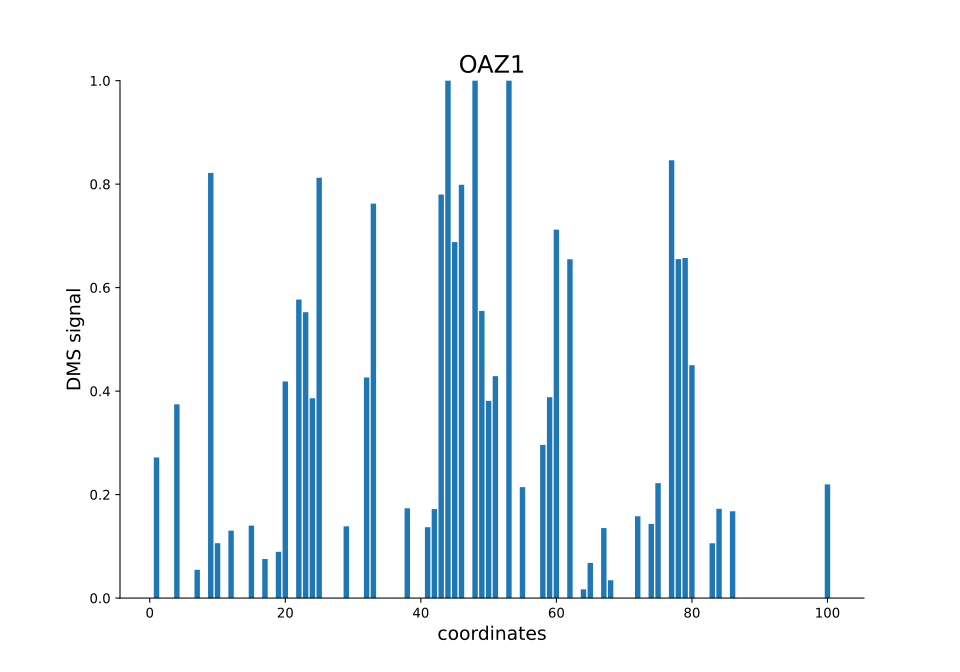
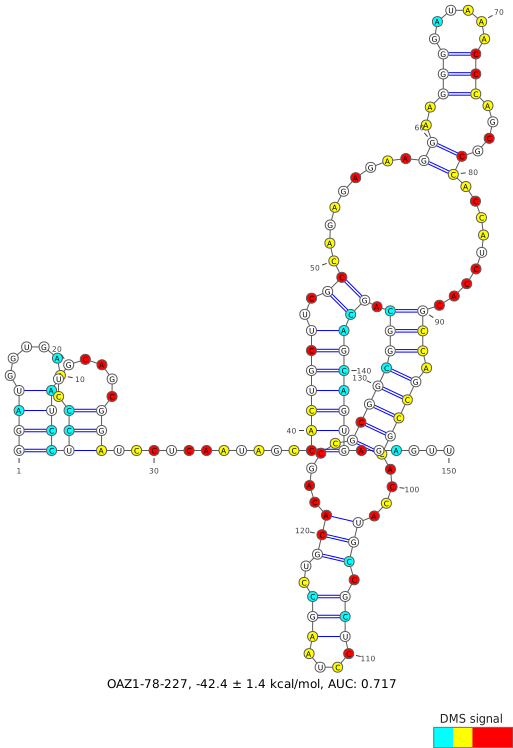
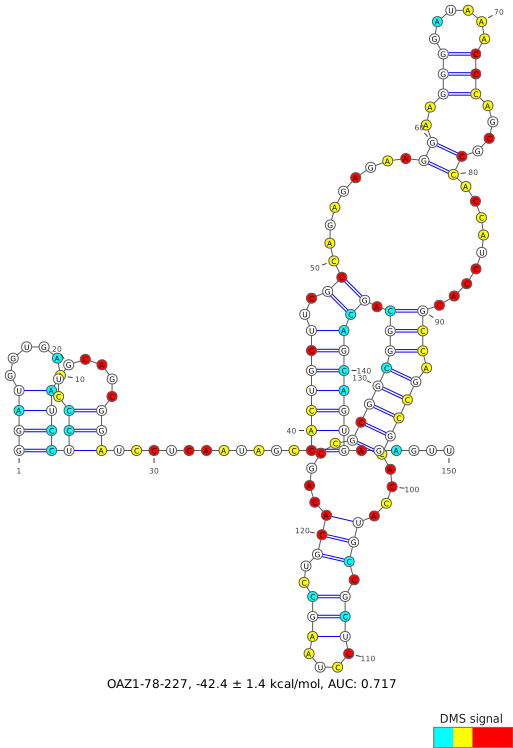
OAZ1 19 2272758 - 2272820, 2272972 - 2273008 +


  • Annotation Based on canonical annotations, the following gene is in your area of interest: OAZ1(+)
  • Length Length of region: 100 nt.
  • Coverage 100.0% of the region's A/C bases included in the filtered DMS dataset. Ideally, this number should be as high as possible for an experimenally-accurate prediction, and over 70% is recommended.
  • Structures This region has 3 maximum predicted structures. 5 is the maximum structures visible on this site. For up to 20 predictions per region, download and run the code locally.
production / bf240190b0 / 2026-02-20 17:46