How to predict by coordinate

Input the genomic coordinates of your region of interest, using hg38 as the reference genome. This input is the most flexible, and is unconstrained by sequencing coverage or any annotation. Be sure to double-check that the output sequence matches your expected region, and check that the output coverage of A/C bases is above the recommended 70%, which is reflective of DMS-modifiable bases meeting all coverage and quality filters.

For most users, only one set of coordinates will be used to define their region of interest. However, two sets of coordinates may be needed when joining two separate regions together, such as when crossing a splice junction.

When analyzing a region within a larger transcript, it is generally recommended to test “buffer” regions, where the region of interest should be extended by 20-50 nt on each end in order to reduce the likelihood of structures being arbitrarily interrupted by the region borders.

Due to computational and server constraints, users will be limited to a maximum input length of 500 nucleotides and a maximum output of 5 predicted structures, though some regions may yield fewer than that. If this does not suit your needs, consider downloading and running the data and code locally (see Download ).
Predict by Gene


Advanced Options
Chromosomal Coordinates (max 500bp)
Coords 1  
Additional Coordinates
Coords 2 Optional
Coords 3 Optional
Coords 4 Optional


THAP12
ENST00000260045 (-) ENSG00000137492 (-)

Visualize entire gene
100
150
300
500
+
-
Predict

  Region Local Coords Chrom Coords Length R N Gini Action
1
5'UTR 103-190 76380943-76381030 88 0.1288 50 0.31
2
5'UTR,CDS 191-301 76380832-76380942 111 0.9425 50 0.66
3
CDS 303-391 76365967-76365972 / 76380748-76380830 89 0.7248 50 0.28
4
CDS 393-486 76365872-76365965 94 0.5515 50 0.18
5
CDS 487-578 76360992-76361063 / 76365852-76365871 92 0.7271 50 0.28
6
CDS 579-650 76355619-76355654 / 76360956-76360991 72 0.7212 50 0.23
7
CDS 651-722 76352724-76352794 / 76355618-76355618 72 0.7490 50 0.29
8
CDS 724-810 76352636-76352722 87 0.8050 50 0.31
9
CDS 812-906 76352540-76352634 95 0.8881 50 0.36
10
CDS 909-1015 76352431-76352537 107 0.7839 50 0.27
11
CDS 1017-1119 76352327-76352429 103 0.8235 50 0.26
12
CDS 1120-1231 76352215-76352326 112 0.8546 50 0.27
13
CDS 1233-1351 76352095-76352213 119 0.7376 50 0.22
14
CDS 1352-1462 76351984-76352094 111 0.8107 50 0.25
15
CDS 1469-1559 76351887-76351977 91 0.8514 50 0.31
16
CDS 1560-1670 76351776-76351886 111 0.7809 50 0.26
17
CDS 1674-1790 76351656-76351772 117 0.7229 50 0.27
18
CDS 1791-1891 76351555-76351655 101 0.6797 50 0.29
19
CDS 1894-1984 76351462-76351552 91 0.8825 50 0.38
20
CDS 1985-2071 76351375-76351461 87 0.8277 50 0.32
21
CDS 2073-2158 76351288-76351373 86 0.7081 50 0.24
22
CDS 2161-2249 76351197-76351285 89 0.7444 50 0.28
23
CDS 2250-2352 76351094-76351196 103 0.8546 50 0.32
24
CDS 2355-2453 76350993-76351091 99 0.7828 50 0.28
25
CDS 2458-2550 76350896-76350988 93 0.6580 50 0.23
26
CDS,3'UTR 2551-2650 76350796-76350895 100 0.5774 50 0.23
27
3'UTR 2651-2744 76350702-76350795 94 0.7434 50 0.23
28
3'UTR 2745-2860 76350586-76350701 116 0.8218 50 0.30
29
3'UTR 2862-2983 76350463-76350584 122 0.8306 50 0.28
30
3'UTR 2987-3078 76350368-76350459 92 0.7620 50 0.29
31
3'UTR 3079-3193 76350253-76350367 115 0.8722 50 0.39
32
3'UTR 3195-3316 76350130-76350251 122 0.8886 50 0.39
33
3'UTR 3317-3409 76350037-76350129 93 0.7086 50 0.33
34
3'UTR 3410-3473 76349973-76350036 64 0.3226 28 0.33
Download CSV

Custom Gene Windows

No custom gene windows have been created yet.
Gene Window Instructions/Interpretation
  1. Search for a gene by name. For each gene, only the canonical transcript (as defined by UCSC in GRCh38.106) is shown. Some gene names may correspond to multiple genomic locations.
  2. For the selected gene, a scatterplot showing the Gini indices, where a high Gini index corresponds to a highly-structured region, for small windows within the transcript. For small RNAs, these windows are sized 20 valid (coverage- and quality-filtered) A/C data points; for all other transcripts, these windows are sized 50 valid A/C data points, due to the ability of DMS to modify primarily A/C bases. In regions with sufficient coverage, these windows correspond to actual transcript lengths of roughly 40 and 100 nucleotides, respectively.
  3. Select a window of interest, either from the scatter plot or from the table below. Generally, windows with a high Gini will yield better results, where the DMS signal aligns more accurately with the predicted base-pais. Windows with high Gini indices relative to the rest of the transcript can also be used to find functional structural elements (ex: TFRC iron response elements).
  4. If previously-defined windows do not suit your needs, you can define a custom window either using (1) the slider below the scatterplot, which shows both a heatmap of previously-defined windows as well as the locations of each UTR and CDS; or (2) custom coordinate-based entry via Predict by Coordinates.
See About for more information on the dataset and for best practices in structure determination.

completed
6
THAP12

Aoi: Chr: Coords Strand:
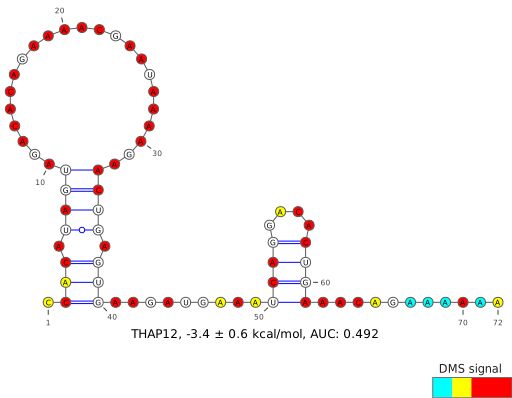
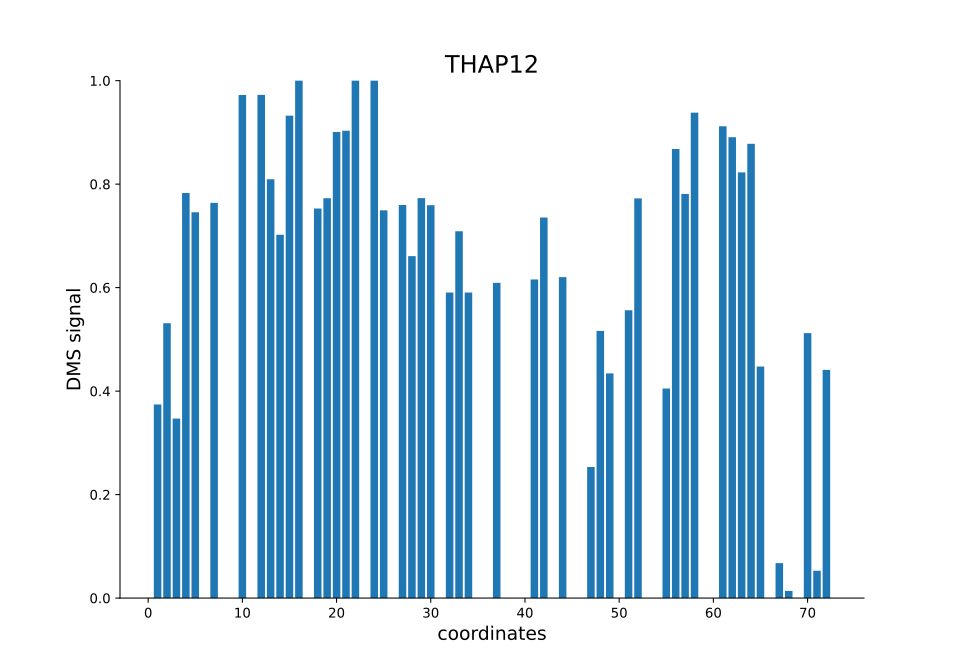
THAP12 11 76355619 - 76355654, 76360956 - 76360991 -


  • Annotation Based on canonical annotations, the following gene is in your area of interest: THAP12(-)
  • Length Length of region: 72 nt.
  • Coverage 100.0% of the region's A/C bases included in the filtered DMS dataset. Ideally, this number should be as high as possible for an experimenally-accurate prediction, and over 70% is recommended.
  • Structures This region has 1 maximum predicted structures. 5 is the maximum structures visible on this site. For up to 20 predictions per region, download and run the code locally.
production / 05e29e215d / 2026-04-04 05:59