How to predict by coordinate

Input the genomic coordinates of your region of interest, using hg38 as the reference genome. This input is the most flexible, and is unconstrained by sequencing coverage or any annotation. Be sure to double-check that the output sequence matches your expected region, and check that the output coverage of A/C bases is above the recommended 70%, which is reflective of DMS-modifiable bases meeting all coverage and quality filters.

For most users, only one set of coordinates will be used to define their region of interest. However, two sets of coordinates may be needed when joining two separate regions together, such as when crossing a splice junction.

When analyzing a region within a larger transcript, it is generally recommended to test “buffer” regions, where the region of interest should be extended by 20-50 nt on each end in order to reduce the likelihood of structures being arbitrarily interrupted by the region borders.

Due to computational and server constraints, users will be limited to a maximum input length of 500 nucleotides and a maximum output of 5 predicted structures, though some regions may yield fewer than that. If this does not suit your needs, consider downloading and running the data and code locally (see Download ).
Predict by Gene


Advanced Options
Chromosomal Coordinates (max 500bp)
Coords 1  
Additional Coordinates
Coords 2 Optional
Coords 3 Optional
Coords 4 Optional


EIF2S3
ENST00000253039 (+) ENSG00000130741 (+)

Visualize entire gene
100
150
300
500
+
-
Predict

  Region Local Coords Chrom Coords Length R N Gini Action
1
5'UTR,CDS 1-104 24054956-24055037 / 24055615-24055636 104 0.5048 50 0.27
2
CDS 108-190 24055640-24055678 / 24057421-24057464 83 0.5192 50 0.21
3
CDS 192-291 24057466-24057548 / 24057633-24057649 100 0.7612 50 0.23
4
CDS 292-386 24057650-24057744 95 0.7385 50 0.21
5
CDS 387-509 24057745-24057754 / 24060088-24060182 / 24062416-24062433 123 0.7241 50 0.22
6
CDS 510-600 24062434-24062524 91 0.6989 50 0.21
7
CDS 601-690 24062525-24062574 / 24064201-24064240 90 0.7614 50 0.23
8
CDS 692-782 24064242-24064332 91 0.7825 50 0.24
9
CDS 788-904 24066000-24066092 / 24067964-24067987 117 0.7435 50 0.19
10
CDS 905-1005 24067988-24068088 101 0.7615 50 0.21
11
CDS 1008-1119 24068091-24068108 / 24071558-24071651 112 0.7579 50 0.27
12
CDS 1120-1215 24071652-24071727 / 24073091-24073110 96 0.7152 50 0.21
13
CDS 1218-1329 24073113-24073224 112 0.7356 50 0.19
14
CDS 1330-1425 24073225-24073263 / 24076722-24076778 96 0.8208 50 0.18
15
CDS,3'UTR 1428-1533 24076781-24076886 106 0.7945 50 0.18
16
3'UTR 1534-1665 24076887-24077018 132 0.8656 50 0.39
17
3'UTR 1666-1795 24077019-24077148 130 0.7939 50 0.32
18
3'UTR 1796-1890 24077149-24077243 95 0.8548 50 0.42
19
3'UTR 1893-1999 24077246-24077352 107 0.8819 50 0.41
20
3'UTR 2000-2078 24077353-24077431 79 0.8010 50 0.30
21
3'UTR 2079-2183 24077432-24077536 105 0.6840 50 0.24
22
3'UTR 2185-2298 24077538-24077651 114 0.5101 50 0.27
23
3'UTR 2301-2389 24077654-24077742 89 0.6645 50 0.35
24
3'UTR 2394-2495 24077747-24077848 102 0.5592 50 0.32
25
3'UTR 2497-2616 24077850-24077969 120 0.5620 50 0.32
26
3'UTR 2617-2735 24077970-24078088 119 0.7401 50 0.45
27
3'UTR 2737-2831 24078090-24078184 95 0.4760 50 0.38
28
3'UTR 2832-2944 24078185-24078297 113 0.5828 50 0.44
29
3'UTR 2947-3085 24078300-24078438 139 0.5450 50 0.39
30
3'UTR 3088-3200 24078441-24078553 113 0.3839 50 0.31
31
3'UTR 3203-3334 24078556-24078687 132 0.3771 50 0.29
32
3'UTR 3336-3405 24078689-24078758 70 0.0570 28 0.31
Download CSV

Custom Gene Windows

Gene Window Instructions/Interpretation
  1. Search for a gene by name. For each gene, only the canonical transcript (as defined by UCSC in GRCh38.106) is shown. Some gene names may correspond to multiple genomic locations.
  2. For the selected gene, a scatterplot showing the Gini indices, where a high Gini index corresponds to a highly-structured region, for small windows within the transcript. For small RNAs, these windows are sized 20 valid (coverage- and quality-filtered) A/C data points; for all other transcripts, these windows are sized 50 valid A/C data points, due to the ability of DMS to modify primarily A/C bases. In regions with sufficient coverage, these windows correspond to actual transcript lengths of roughly 40 and 100 nucleotides, respectively.
  3. Select a window of interest, either from the scatter plot or from the table below. Generally, windows with a high Gini will yield better results, where the DMS signal aligns more accurately with the predicted base-pais. Windows with high Gini indices relative to the rest of the transcript can also be used to find functional structural elements (ex: TFRC iron response elements).
  4. If previously-defined windows do not suit your needs, you can define a custom window either using (1) the slider below the scatterplot, which shows both a heatmap of previously-defined windows as well as the locations of each UTR and CDS; or (2) custom coordinate-based entry via Predict by Coordinates.
See About for more information on the dataset and for best practices in structure determination.

completed
4
EIF2S3

Aoi: Chr: Coords Strand:
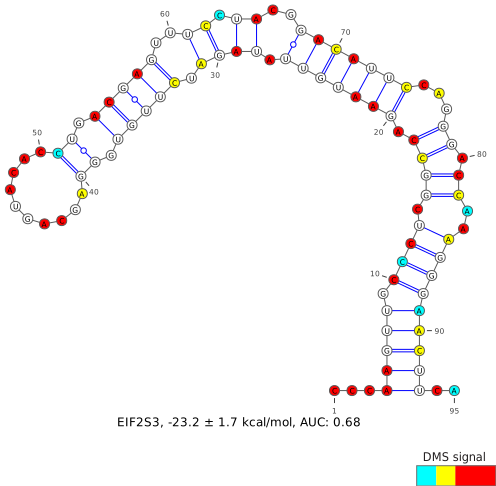
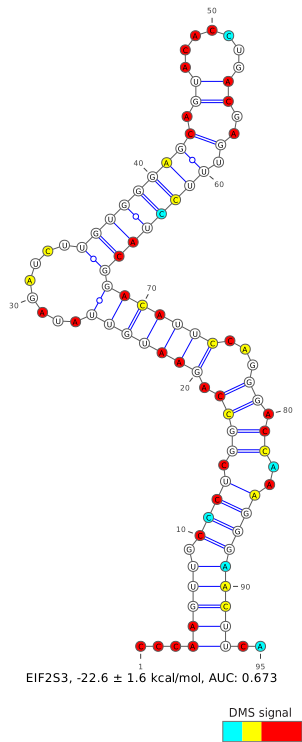
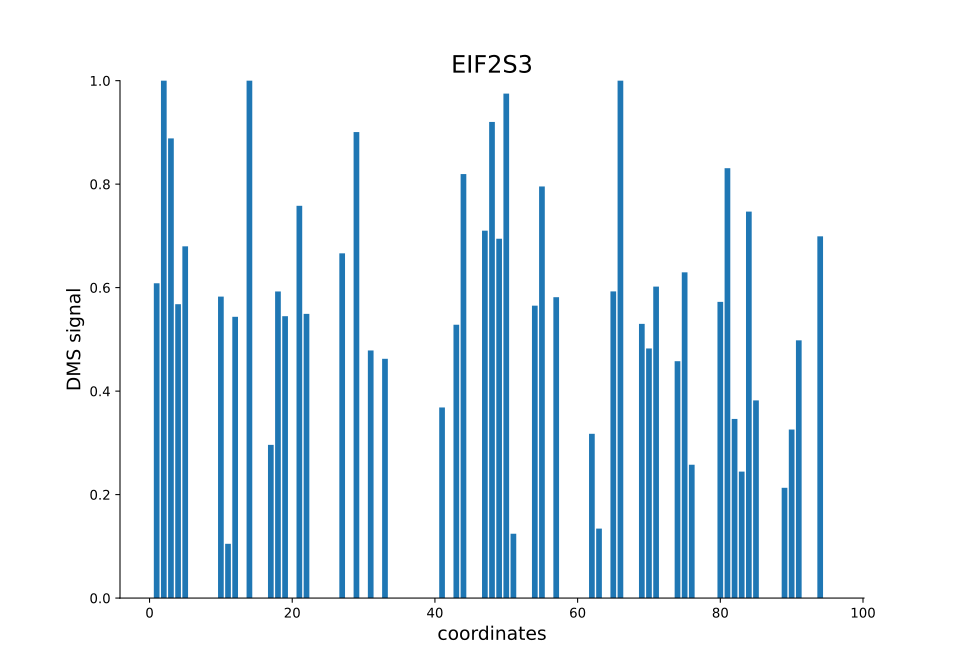
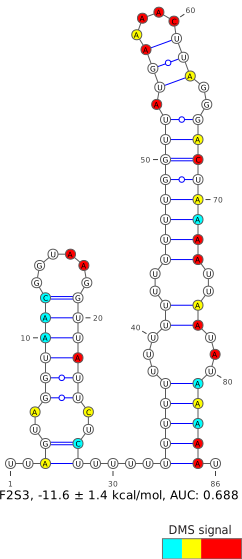
EIF2S3 X 24057650 - 24057744 +


  • Annotation Based on canonical annotations, the following gene is in your area of interest: EIF2S3(+)
  • Length Length of region: 95 nt.
  • Coverage 100.0% of the region's A/C bases included in the filtered DMS dataset. Ideally, this number should be as high as possible for an experimenally-accurate prediction, and over 70% is recommended.
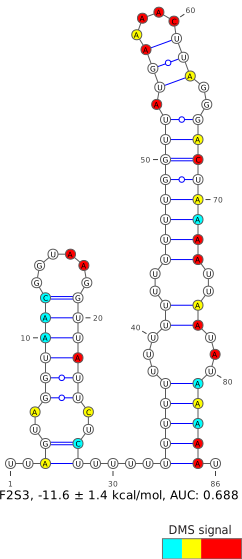
  • Structures This region has 2 maximum predicted structures. 5 is the maximum structures visible on this site. For up to 20 predictions per region, download and run the code locally.
production / 05e29e215d / 2026-04-04 19:29