How to predict by coordinate

Input the genomic coordinates of your region of interest, using hg38 as the reference genome. This input is the most flexible, and is unconstrained by sequencing coverage or any annotation. Be sure to double-check that the output sequence matches your expected region, and check that the output coverage of A/C bases is above the recommended 70%, which is reflective of DMS-modifiable bases meeting all coverage and quality filters.

For most users, only one set of coordinates will be used to define their region of interest. However, two sets of coordinates may be needed when joining two separate regions together, such as when crossing a splice junction.

When analyzing a region within a larger transcript, it is generally recommended to test “buffer” regions, where the region of interest should be extended by 20-50 nt on each end in order to reduce the likelihood of structures being arbitrarily interrupted by the region borders.

Due to computational and server constraints, users will be limited to a maximum input length of 500 nucleotides and a maximum output of 5 predicted structures, though some regions may yield fewer than that. If this does not suit your needs, consider downloading and running the data and code locally (see Download ).
Predict by Gene


Advanced Options
Chromosomal Coordinates (max 500bp)
Coords 1  
Additional Coordinates
Coords 2 Optional
Coords 3 Optional
Coords 4 Optional


ZNF260
ENST00000523638 (-) ENSG00000254004 (-)

Visualize entire gene
100
150
300
500
+
-
Predict

  Region Local Coords Chrom Coords Length R N Gini Action
1
5'UTR,CDS 730-826 36515146-36515242 97 0.3459 50 0.40
2
CDS 830-918 36515054-36515142 89 0.4525 50 0.33
3
CDS 919-1009 36514963-36515053 91 0.2838 50 0.34
4
CDS 1010-1125 36514847-36514962 116 0.2520 50 0.31
5
CDS 1126-1209 36514763-36514846 84 0.3292 50 0.38
6
CDS 1213-1292 36514680-36514759 80 0.3014 50 0.40
7
CDS 1293-1385 36514587-36514679 93 0.3551 50 0.38
8
CDS 1386-1473 36514499-36514586 88 0.0833 50 0.33
9
CDS 1476-1930 36514042-36514496 455 0.4805 50 0.39
10
CDS,3'UTR 1931-2020 36513952-36514041 90 0.2911 50 0.34
11
3'UTR 2021-2119 36513853-36513951 99 0.5433 50 0.35
12
3'UTR 2121-2229 36513743-36513851 109 0.3816 50 0.37
13
3'UTR 2230-2340 36513632-36513742 111 0.3652 50 0.38
14
3'UTR 2341-2438 36513534-36513631 98 0.2040 50 0.33
15
3'UTR 2439-2547 36513425-36513533 109 0.3319 50 0.39
16
3'UTR 2548-2629 36513343-36513424 82 0.2157 50 0.37
17
3'UTR 2630-2731 36513241-36513342 102 0.2768 50 0.40
18
3'UTR 2736-2825 36513147-36513236 90 0.3470 50 0.39
19
3'UTR 2827-2979 36512993-36513145 153 0.3058 50 0.34
20
3'UTR 2980-3086 36512886-36512992 107 0.2008 60 0.30
Download CSV

Custom Gene Windows

No custom gene windows have been created yet.
Gene Window Instructions/Interpretation
  1. Search for a gene by name. For each gene, only the canonical transcript (as defined by UCSC in GRCh38.106) is shown. Some gene names may correspond to multiple genomic locations.
  2. For the selected gene, a scatterplot showing the Gini indices, where a high Gini index corresponds to a highly-structured region, for small windows within the transcript. For small RNAs, these windows are sized 20 valid (coverage- and quality-filtered) A/C data points; for all other transcripts, these windows are sized 50 valid A/C data points, due to the ability of DMS to modify primarily A/C bases. In regions with sufficient coverage, these windows correspond to actual transcript lengths of roughly 40 and 100 nucleotides, respectively.
  3. Select a window of interest, either from the scatter plot or from the table below. Generally, windows with a high Gini will yield better results, where the DMS signal aligns more accurately with the predicted base-pais. Windows with high Gini indices relative to the rest of the transcript can also be used to find functional structural elements (ex: TFRC iron response elements).
  4. If previously-defined windows do not suit your needs, you can define a custom window either using (1) the slider below the scatterplot, which shows both a heatmap of previously-defined windows as well as the locations of each UTR and CDS; or (2) custom coordinate-based entry via Predict by Coordinates.
See About for more information on the dataset and for best practices in structure determination.

completed
4
ZNF260

Aoi: Chr: Coords Strand:
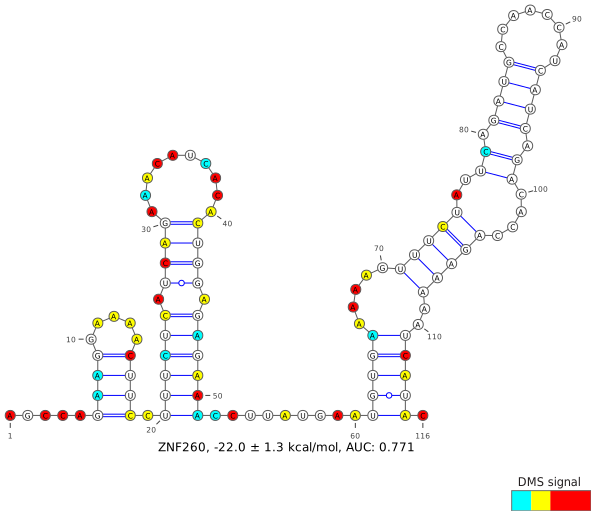
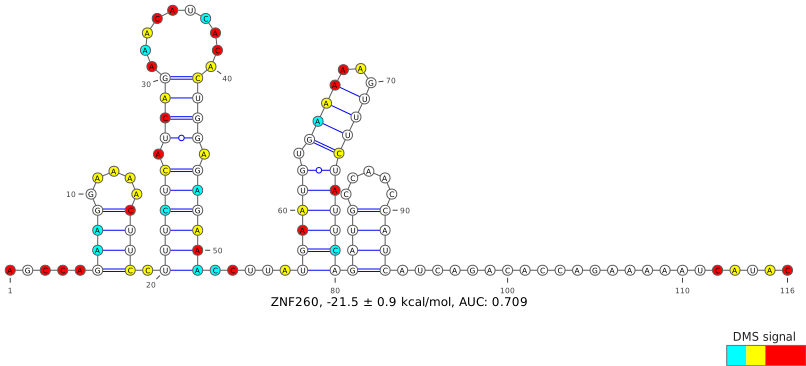
ZNF260 19 36514847 - 36514962 -


  • Annotation Based on canonical annotations, the following gene is in your area of interest: ZNF260(-)
  • Length Length of region: 116 nt.
  • Structures This region has 2 maximum predicted structures. 5 is the maximum structures visible on this site. For up to 20 predictions per region, download and run the code locally.
  • Coverage 67.60000000000001% of the region's A/C bases included in the filtered DMS dataset. This is lower than the recommended 70%. While structure prediction is still possible even without any coverage, the structures will be based on the sequence alone, rather than based on experimental constraints.
production / 05e29e215d / 2026-04-03 23:35