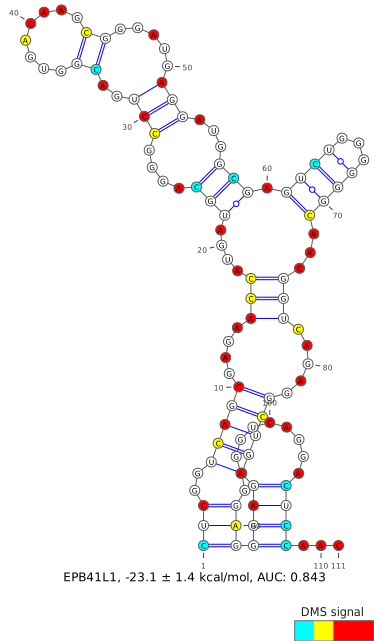
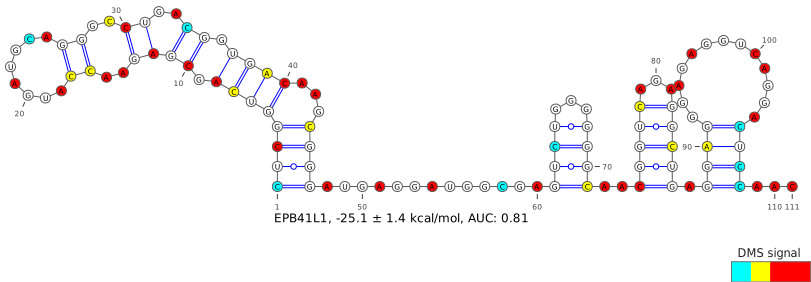
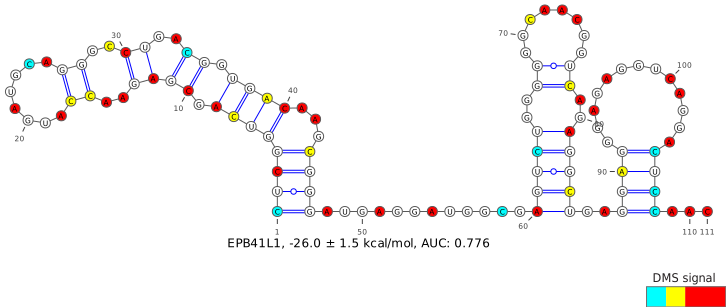
How to predict by coordinate

Input the genomic coordinates of your region of interest, using hg38 as the reference genome. This input is the most flexible, and is unconstrained by sequencing coverage or any annotation. Be sure to double-check that the output sequence matches your expected region, and check that the output coverage of A/C bases is above the recommended 70%, which is reflective of DMS-modifiable bases meeting all coverage and quality filters.

For most users, only one set of coordinates will be used to define their region of interest. However, two sets of coordinates may be needed when joining two separate regions together, such as when crossing a splice junction.

When analyzing a region within a larger transcript, it is generally recommended to test “buffer” regions, where the region of interest should be extended by 20-50 nt on each end in order to reduce the likelihood of structures being arbitrarily interrupted by the region borders.

Due to computational and server constraints, users will be limited to a maximum input length of 500 nucleotides and a maximum output of 5 predicted structures, though some regions may yield fewer than that. If this does not suit your needs, consider downloading and running the data and code locally (see Download ).
Predict by Gene


Advanced Options
Chromosomal Coordinates (max 500bp)
Coords 1  
Additional Coordinates
Coords 2 Optional
Coords 3 Optional
Coords 4 Optional


EPB41L1
ENST00000628415 (+) ENSG00000088367 (+)

Visualize entire gene
100
150
300
500
+
-
Predict

  Region Local Coords Chrom Coords Length R N Gini Action
1
CDS 263-348 36175551-36175636 86 0.5989 50 0.33
2
CDS 350-463 36175638-36175715 / 36177952-36177987 114 0.5864 50 0.38
3
CDS 468-551 36177992-36178056 / 36178630-36178648 84 0.6808 50 0.41
4
CDS 552-640 36178649-36178672 / 36182272-36182336 89 0.6153 50 0.41
5
CDS 642-733 36182338-36182347 / 36185117-36185198 92 0.5707 50 0.39
6
CDS 735-840 36185200-36185305 106 0.6803 50 0.36
7
CDS 842-934 36185307-36185335 / 36187676-36187739 93 0.6056 50 0.30
8
CDS 937-1034 36187742-36187763 / 36188347-36188422 98 0.4719 50 0.31
9
CDS 1035-1129 36188423-36188499 / 36190277-36190294 95 0.5827 50 0.37
10
CDS 1130-1221 36190295-36190374 / 36190622-36190633 92 0.4314 50 0.33
11
CDS 1224-1312 36190636-36190724 89 0.4583 50 0.38
12
CDS 1313-1404 36190725-36190797 / 36194212-36194230 92 0.3671 50 0.36
13
CDS 1405-1515 36194231-36194341 111 0.5309 50 0.34
14
CDS 1516-1599 36194342-36194360 / 36197859-36197923 84 0.4917 50 0.35
15
CDS 1600-1680 36197924-36198004 81 0.5741 50 0.39
16
CDS 1681-1756 36198005-36198041 / 36212272-36212310 76 0.5490 50 0.39
17
CDS 1757-1864 36212311-36212376 / 36214357-36214398 108 0.6983 50 0.36
18
CDS 1865-1943 36214399-36214440 / 36218876-36218912 79 0.6799 50 0.44
19
CDS 1946-2031 36218915-36218962 / 36219761-36219798 86 0.7543 50 0.37
20
CDS 2032-2110 36219799-36219844 / 36221864-36221896 79 0.6643 50 0.36
21
CDS 2112-2204 36221898-36221944 / 36222278-36222323 93 0.4938 50 0.34
22
CDS,3'UTR 2207-2285 36222326-36222394 / 36229332-36229341 79 0.5751 50 0.32
23
3'UTR 2286-2375 36229342-36229431 90 0.7209 50 0.34
24
3'UTR 2378-2472 36229434-36229528 95 0.5767 50 0.28
25
3'UTR 2473-2562 36229529-36229618 90 0.7049 50 0.33
26
3'UTR 2563-2647 36229619-36229703 85 0.7396 50 0.41
27
3'UTR 2648-2733 36229704-36229789 86 0.5774 50 0.28
28
3'UTR 2734-2815 36229790-36229871 82 0.5705 50 0.35
29
3'UTR 2817-2889 36229873-36229945 73 0.5962 50 0.31
30
3'UTR 2893-2980 36229949-36230036 88 0.6415 50 0.35
31
3'UTR 2984-3238 36230040-36230294 255 0.6134 52 0.37
Download CSV

Custom Gene Windows

No custom gene windows have been created yet.
Gene Window Instructions/Interpretation
  1. Search for a gene by name. For each gene, only the canonical transcript (as defined by UCSC in GRCh38.106) is shown. Some gene names may correspond to multiple genomic locations.
  2. For the selected gene, a scatterplot showing the Gini indices, where a high Gini index corresponds to a highly-structured region, for small windows within the transcript. For small RNAs, these windows are sized 20 valid (coverage- and quality-filtered) A/C data points; for all other transcripts, these windows are sized 50 valid A/C data points, due to the ability of DMS to modify primarily A/C bases. In regions with sufficient coverage, these windows correspond to actual transcript lengths of roughly 40 and 100 nucleotides, respectively.
  3. Select a window of interest, either from the scatter plot or from the table below. Generally, windows with a high Gini will yield better results, where the DMS signal aligns more accurately with the predicted base-pais. Windows with high Gini indices relative to the rest of the transcript can also be used to find functional structural elements (ex: TFRC iron response elements).
  4. If previously-defined windows do not suit your needs, you can define a custom window either using (1) the slider below the scatterplot, which shows both a heatmap of previously-defined windows as well as the locations of each UTR and CDS; or (2) custom coordinate-based entry via Predict by Coordinates.
See About for more information on the dataset and for best practices in structure determination.

completed
13
EPB41L1

Aoi: Chr: Coords Strand:
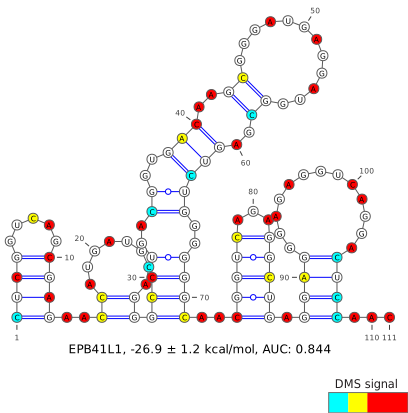
EPB41L1 20 36194231 - 36194341 +


  • Annotation Based on canonical annotations, the following gene is in your area of interest: EPB41L1(+)
  • Length Length of region: 111 nt.
  • Coverage 100.0% of the region's A/C bases included in the filtered DMS dataset. Ideally, this number should be as high as possible for an experimenally-accurate prediction, and over 70% is recommended.
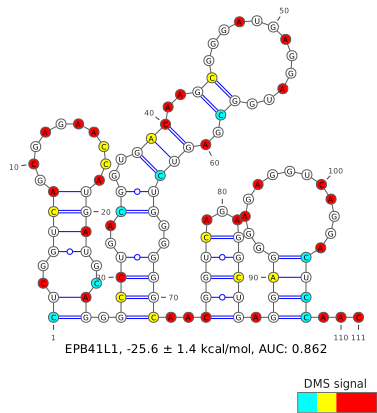
  • Structures This region has 7 maximum predicted structures. 5 is the maximum structures visible on this site. For up to 20 predictions per region, download and run the code locally.
production / 6840c0a13a / 2026-06-07 23:23